Bucknell University’s Revolutionizing Engineering Departments project
Each of us hold multiple mental frameworks we rely on to function in our daily lives. A framework is just the collection of knowledge and habits situated to your environment, that is your mental models of the world fits where you live and work. In other words, mental frameworks are ways of thinking and sets of habits that help us make sense of our world and which make our day-to-day decisions easier. However if the external environment changes around us, our frameworks can become maladapted – they slowly stop making sense. When that happens we need to explore other ways of understanding our place in the world.
The Bucknell University Revolutionizing Engineering Departments (RED) project sought to explore new frameworks on which to base engineering education. The current frameworks that inform how we teach engineers are based on a 20th Century model that views engineering as a technological means to the economic ends of production. There are two reasons to question the utility of this framework in the 21st Century:
- First, its priorities are misaligned with reality. Engineering won. Products today are much cheaper and more widely accessible than a century ago. But this abundance has created new challenges – inequities in access, the environmental costs of high levels of production, and economic turbulence as economies shift away from goods. We are not adequately preparing students to address these new challenges.
- Second, the focus on production led to an education system that does not recognize our students’ humanity. In seeking to maximize production, we unconsciously started to treat students as a product by adopting outcomes-based education and methods of continual quality improvement.
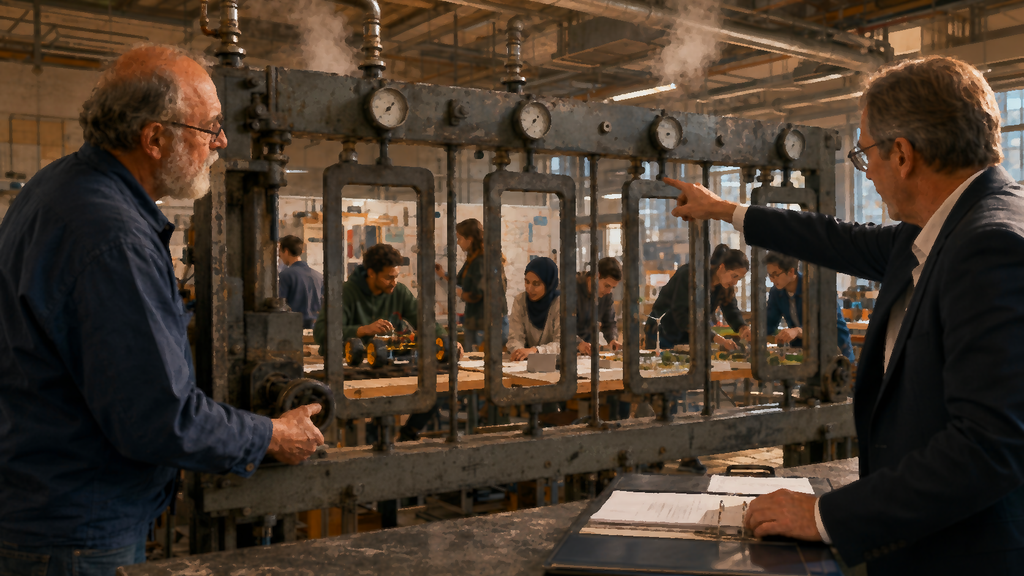
[TEAM – I AM LOOKING FOR FEEDBACK ON AI-GENERATED IMAGES. THEY MAKE A POINT BUT I CAN SEE WHY WE SHOULD NOT HAVE THEM.]
The challenges we face today are not those of the last century that engineering education was designed to support. So we must begin to think about changing, and that starts with critiquing our frameworks. Because engineering has been so successful at what it was designed to do the frameworks that inform how we teach students are deeply embedded; so much so that changing them is almost unimaginable. To even think about questioning the “…the magnificent edifice of [engineering], and…how absolutely impersonal it stands in its vast augustness” might even be called…revolutionary.
Navigating the Site
- The About page provides a concise background for the RED project.
- The Red Team highlights the people involved.
- RED Efforts is the main source of information on our achievements.
- Results & Resources provides links to publications and other project results.
- Contact provides information on how to reach us.
This project was funded by the National Science Foundation’s Engineering Education and Centers Division under number 2022271. Any opinions, findings, and conclusions or recommendations expressed in this material are those of the author(s) and do not necessarily reflect the views of the National Science Foundation.