Grading is a core function of education, but our RED research found that it is the activity faculty would most like to do less of. If less time were devoted to grading faculty reported there would be more time for more impactful class activities. In this RED project we asked how to reclaim grading in a way that promotes broad student development.
There have been many critiques of grading over the years, including the fact that the grades earned in university are not predictive of future job performance. As far back as 1918 the Mann report noted:
An extended study of [student grades and on-job performance] … showed that the correlation between the two was very slight; that is, that ability to secure high grades in college was no indication of ability to meet the requirements of the General Electric Company.
One of the ways to revolutionize engineering education is by changing deeply embedded structures like grading. Within the current model of higher education grades indicate the knowledge and skills faculty deem important. Because aggregate GPA is a societally recognized achievement which impacts on the post-college opportunities available to students, grades help shape the social structures of how students interact or organize themselves, thereby strongly impacting an individual students’ identity. By informing what stands as valid knowledge, skills, and behaviors within a discipline grades determine what does and does not counts as engineering.
The RED team at Bucknell’s work on grading focuses on two aspects of grading. The first is to changes practices at the micro-scale—e.g. activities and classes—the RED team implemented non-traditional grading techniques like contract or specifications grading; shifting evaluations to use “praise” rubrics (in contrast to rubrics that solely mark deficits). While pervasive these efforts are ad hoc and limited to a individual courses or faculty members.
Second and more significantly, the RED team worked to change the meaning of grades to better indicate students’ longitudinal growth in the many ways of being an engineer. The idea is illustrated in the figure below (click to enlarge).
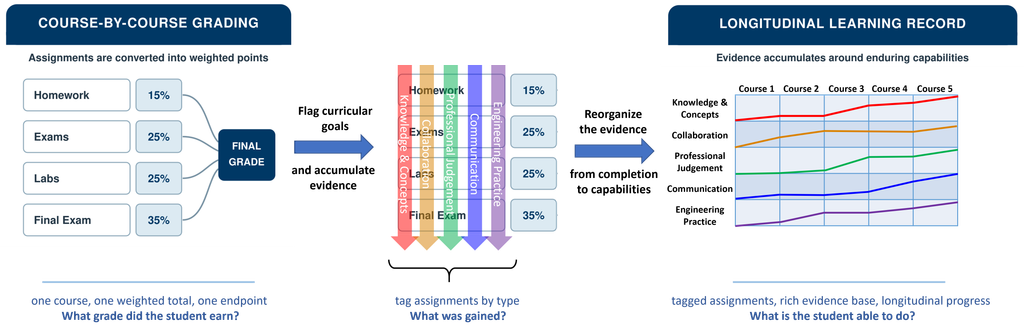
Here individual assignments in courses are tagged by the curricular goal they address in each instructor’s grade sheet. To enable longitudinal and more holistic evaluation, individual grade sheets are read by the Curricular Ontology for the Mapping of Professional Agency, Skills, and Student development (COMPASS) software developed under this project. COMPASS allows faculty to examine performance patterns across courses, semesters, and the full degree program. The system provides a common evidence base for asking precise questions about student growth. It keeps faculty and students informed by linking curricular goals directly to micro-scale evidence at the level of individual assignments. Discussions about student learning often rely on incomplete recollections, isolated course descriptions, or assumptions about what happens elsewhere in a program. COMPASS enables us to examine concrete examples, identify patterns, and negotiate improvements based on evidence rather than speculation.