Understanding the opportunity set students need
While the capability approach emphasizes creating opportunities for students, the real question is “what opportunities” since creating opportunities has real costs. One of our first actions in the grant was to create a list of student opportunities. While there is significant debate in the literature about lists of capabilities, there is generally consensus that lists are ok if they are contextualized to a specific place or group. One gets into trouble trying to create universal lists. As we reviewed the literature on capabilities we realized that many of the existing capability lists were focused on very broad, or high level capabilities. As our goal was to understand specific capabilities in our institutional degree program that were missing for students, we needed a more detailed understanding of capabilities, something that was not addressed in the existing literature base. We brainstormed both inductive and deductive ways to identify particular capabilities, and after several false starts we arrived at an ecosystem metaphor we dubbed the “prairie grass” model.
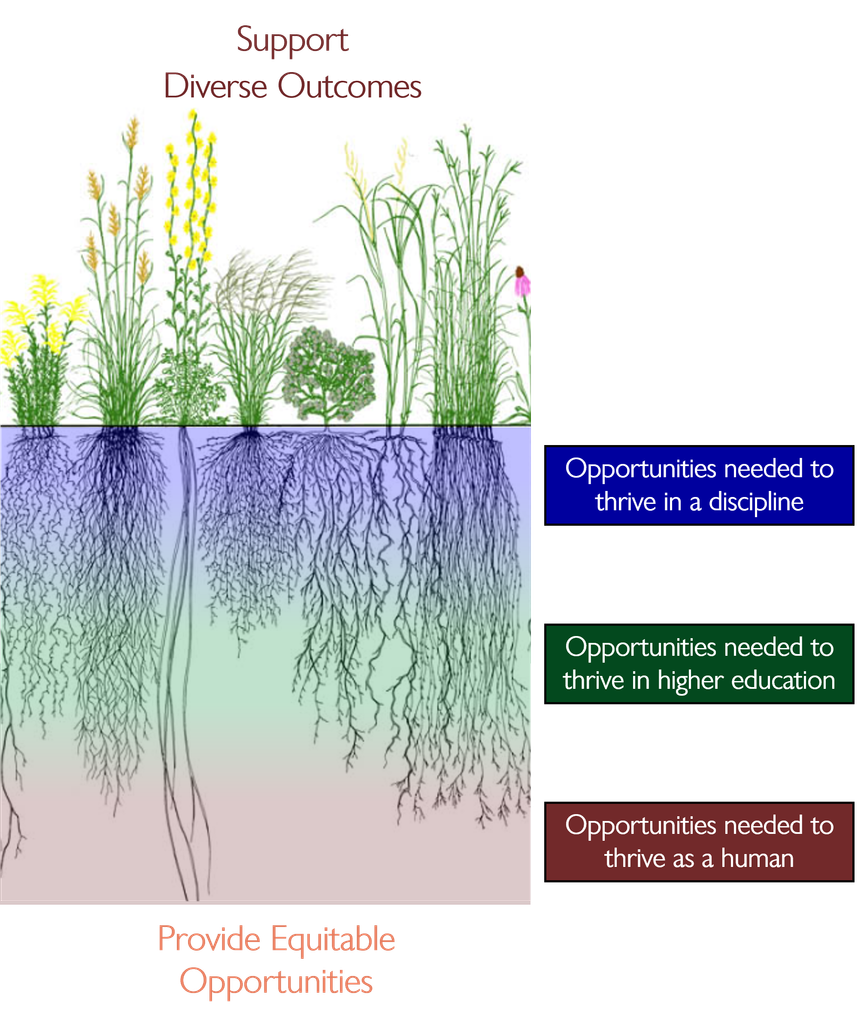
In this metaphor opportunities are the soil in which each plant (student) grows. To survive harsh conditions prairie plants have multilevel root systems—shallow roots to gather nutrients, and deep roots to tap water—symbolizing different layers of student opportunities. In developing our capability list, we drew from the literature, Q-sort data from students, and policy documents in engineering education and Bucknell to define capabilities at the three levels shown in the figure above. This culminated in a list of 12 high-level opportunities and 38 more specific opportunities you can download here.
The most surprising, and also biggest, challenges faced in creating the opportunity list was how hard it was to distinguish opportunities from outcomes. We had become so enculturated into thinking of education in terms of outcomes it was nearly impossible to think outside that framework. The following thoughts offer some ways to think about the difference between opportunities and outcomes:
- An opportunity is not an outcome (what a student can do) or content (what students are expected to know).The “unit of analysis” for opportunities are individual students, for outcomes it is all students.
- Opportunities enable future achievements or provide potential advantage to students who take advantage of them, outcomes…
- Outcomes are mapped to curricula, opportunities are mapped on to the structural elements of the institution that supports attainment.
- Opportunities are phrased in a value-neutral way: faculty may disagree whether the opportunity (or functioning derived therefrom) will benefit the student, discipline, or society. Outcomes are always assumed to be beneficial.
- An opportunity has value as an end in itself rather than (or as well as) as a means to an end. Outcomes are always a means to an external end.
- Opportunities require agency or initiative to take advantage of, and this agency may vary between people. Outcomes are curricular requirements that is mandated for all students independent of their desire to attain it.
- The presence or lack of an opportunity often correlates to privilege, advantages, benefits, or special rights that a person may enjoy due to their social status, position, or circumstances that may be outside their control.