Today’s grand challenges will not be solved by one discipline alone. But the integration of knowledge, methods and expertise from across science and engineering is not simple or automatic. Barriers often slow progress — from outdated educational approaches to rigid organizational structures.
For some time funding agencies have worried about the types of problems that can’t be well addressed through single-investigator research because they are complex, wicked, and thumb their nose at disciplinary boundaries. The term convergence captures these problems, especially those focusing on societal needs. There are many other terms that mean something similar—systems thinking, transdisciplinary research, etc.—but we chose convergence since it aligns with education and science policy. In this paradigm convergent research is driven by a specific and compelling problem and requires meaningful collaboration between intellectually diverse researchers who can communicate across disciplines.
Implicit in convergence is that participants can bring their expertise to the problem space. For this reason most work on convergence is in the post-doctoral space since participants are already experts. Our work, in contrast, looks at convergence in undergraduate programs—working with novices—to better understand how to prepare students earlier in their education to be interested in, and begin to develop attitudes and skills, that support future development to do more convergent work/
Defining Convergence for Undergraduate Programs
Initially we planned to integrate convergence into our program by having convergent projects in all required ECE courses. This turned out to be a much bigger lift than we anticipated. The more we tried to create convergent projects the more we realized that what we wanted to achieve was already happening but it just wasn’t being recognized. What gave the illusion of a narrow and restrictive curriculum was that the frameworks we adopted did not steer attention to the efforts that were ongoing and the ways regular class activities already contributed to convergence. The problem wasn’t in doing, it was in seeing.
This realization caused a shift of our activities away from convergence-based projects and towards identifying core convergence thinking capabilities. It was at this point the capabilities approach and convergence threads of the grant clicked together.
To understand how students were learning convergence capabilities we developed an undergraduate convergence taxonomy and used it to perform a gap analysis on the curriculum. The taxonomy has also enabled us to develop convergence rubrics that are influence how classes are taught.
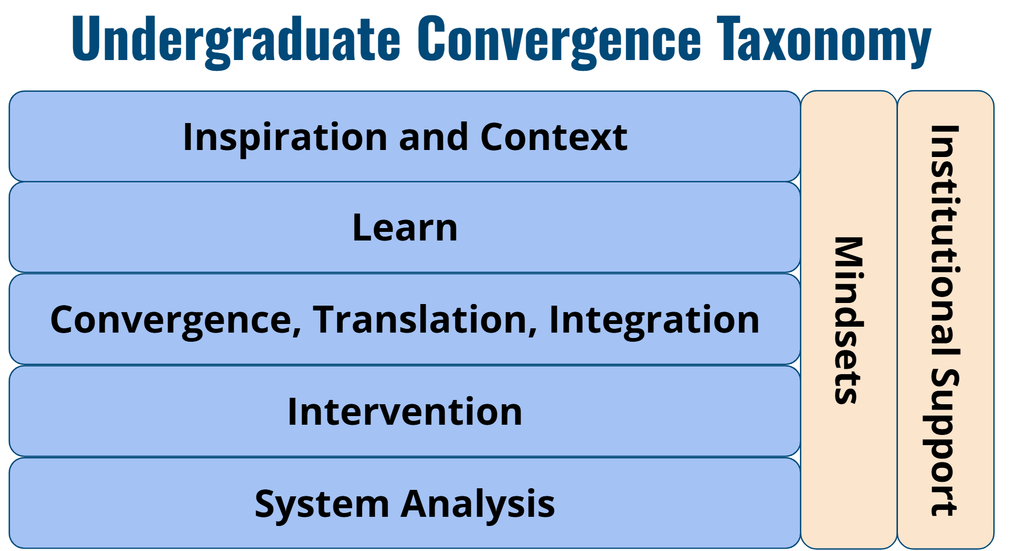
ADD GAP ANALYSIS
ADD LINK TO FINISHED TAXONOMY
One of the more pithy lessons we’ve taken from the work on preparing students for a world with more convergent problems is that the current way we teach and our university structures drive us to make a fruit salad — large chunks of discrete learning mixed up in different ways. Convergence is more like a smoothie with a consistent texture and imperceptible boundaries.