The capability approach as a framework for engineering education
Our work has focused on frameworks—ways of thinking and sets of habits that help us make sense of our world and which make our day-to-day decisions easier. There are many frameworks that impact on engineering education, but the two most influential are outcomes-based education (OBE) and continual quality improvement (CQI) since they are baked in to ABET accreditation. Outcomes-based education focuses educator’s attention on what graduates can demonstrably do and urges us to define common outcomes, assess their attainment, and use results to drive program changes. Being educated as an engineer becomes synonymous, to some extent, with achieving prescribed outcomes. Continual Quality Improvement draws from industrial quality models to reinforce this approach by emphasizing measurable outcomes, reduction of variation, and alignment with standards and external review. Together, OBE and CQI function as a tacit governance system in which programs are accountable to external standards, learning must be documented and measured against thresholds, and improvement is framed as iterative compliance. OBE/CQI is a predictive framework that shapes present actions toward defined future outcomes.
In contrast to outcomes-based education, the capability approach is a normative framework that foregrounds questions of value—what people have reason to value—and therefore what educational systems ought to enable. The capability approach originated in welfare economics and human development to evaluate well-being in terms of individuals’ opportunities and freedom rather than systemic quality or performance guided by metrics such as GDP. Two concepts anchor the capability approach:
- Capabilities are the genuine opportunities (and freedoms from constraint) a person has to pursue valued ways of living.
- Functionings are the achieved beings and doings—recognized accomplishments—realized from that opportunity set.
In any organization, society, or system people convert the capabilities they have access to into functionings they value. To understand how well the system is working for individuals one evaluates what opportunities are available and usable in addition to focusing on peoples’ accomplishments. Because people are different, individual’s disability, talent, resources, and environment shape opportunity their opportunity set and thus what achievements are realistically possible.
In higher education capabilities are the genuine options available to a student—such as access to learning experiences, support systems, or pathways—while functionings are what the student actually chooses to pursue and accomplish with the opportunities college offered. A highly simplified view of how the capability approach adds to existing frameworks in engineering education is:

You can find the more detailed model we used to inform our program revision efforts here. Outcomes—central to the OBE/CQI-based framework—remain important, but are expanded through the inclusion of opportunities (capabilities) on the front end and achievements (functionings) on the back end of curriculum. A focus on outcomes alone is necessary but insufficient. Outcomes are based on opportunities and lead to achievement. Opportunities play a more central role than outcomes, and the capability approach recognizes they may be distributed inequitably given that students draw on different resource pools.
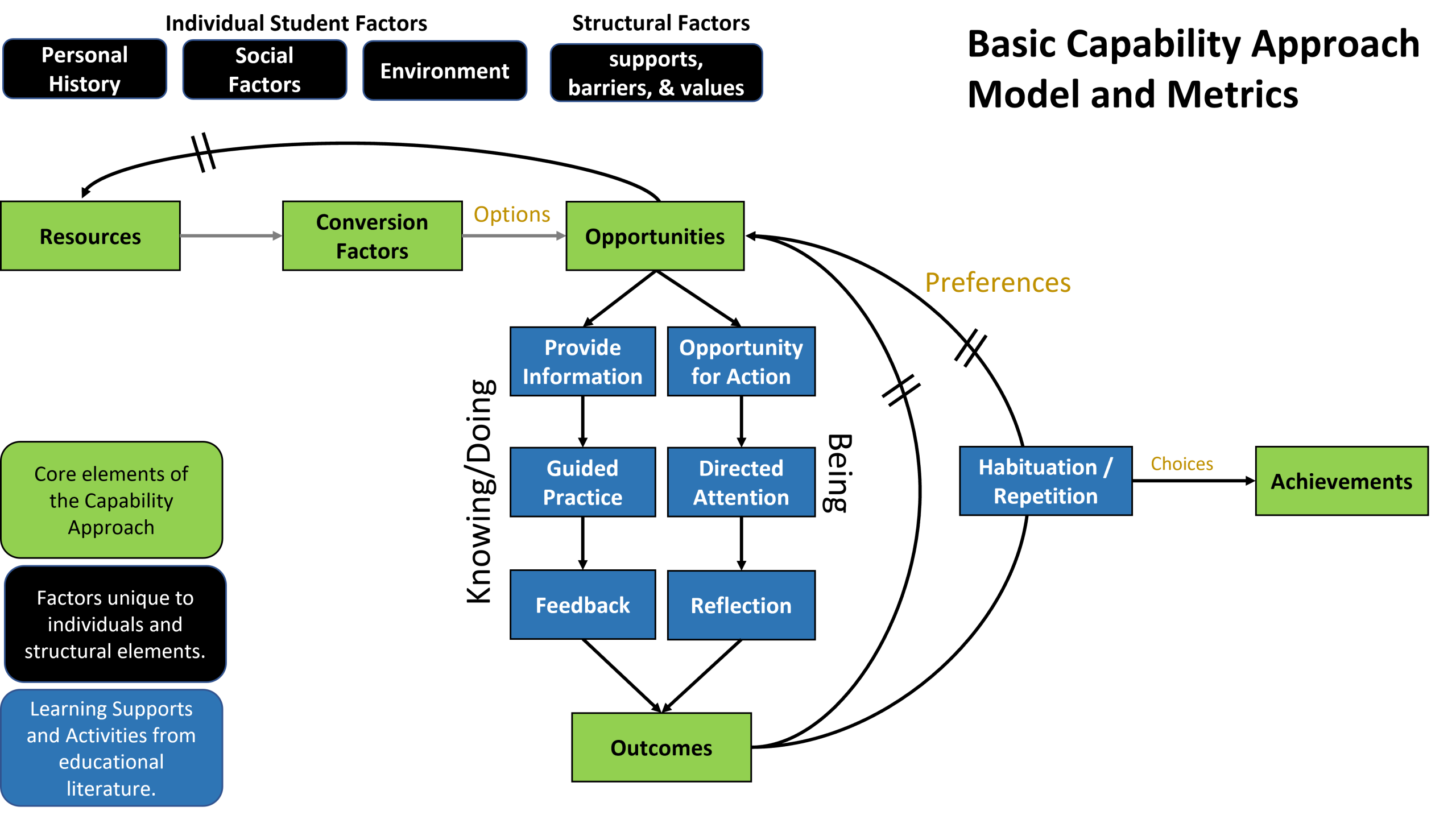
Similarly this framework introduces two new evaluative criteria beyond the extent to which students attain outcomes:
- How equitably distributed is the set of opportunties?
- How aligned are attainable achievements with what is valued in the workforce and society more broadly?
Adopting the capability approach as a framework foundationally changes engineering education by emphasizing what students are actually able to do and become, rather than what programs deliver or what metrics they produce. The capability approach shifts attention from aggregate measures (e.g., outputs, rankings, or income) to the real opportunities individuals have to lead lives they value. In an educational context, this reframes the purpose of a degree program away from producing graduates who meet predefined outcomes to expand students’ meaningful opportunities and their ability to make use of them.